
NTUT 2026 Academic Year Artist-in-Residence Program: Initiating a Dialogue Between Technology and Art
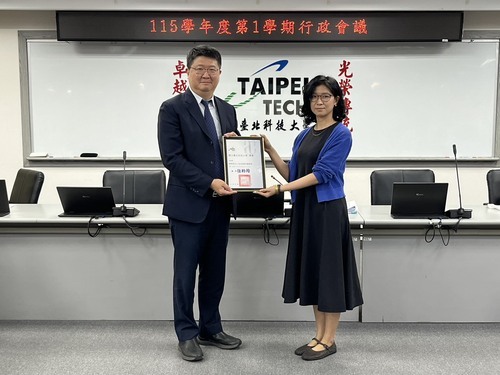
National Taipei University of Technology (NTUT) has invited emerging artist Huang Hua-Chen to serve as its Artist-in-Residence for the 2026 academic year. From August to October 2026, Huang will be based on campus to develop a series of paintings and engage with faculty and students through presentations on her artistic concepts and materials, art workshops, and a subsequent solo exhibition. As a leading university in technical and vocational education, NTUT continues to advance engineering, technology, and practice-oriented education while actively promoting interdisciplinary exchange among art, the humanities, and design. By welcoming an artist to work directly on campus, the program brings art into the everyday environment of a science and engineering university, opening new opportunities for exchange and dialogue across disciplines.
Huang Hua-Chen holds an MFA in Fine Arts from Taipei National University of the Arts and has also studied painting at the Academy of Fine Arts in Finland. Known for her distinctive artistic style, she frequently draws upon natural imagery such as wilderness landscapes, mountain ranges, and indigo-blue seas to explore states of being including solitude, being loved, healing, and freedom. Her works are held in the collections of the Taipei Fine Arts Museum, the National Taiwan Museum of Fine Arts, and the White Rabbit Gallery in Australia. She has also exhibited in cities including Sydney, Tokyo, Seoul, Gwangju, Hong Kong, Helsinki, Milan, Paris, and New York, and has extensive exhibition experience in Taiwan and abroad. She currently teaches in the Department of Fine Arts at Taipei National University of the Arts and the Department of Architecture at Tamkang University.
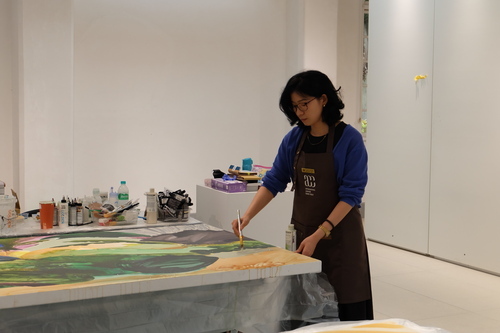
As NTUT’s Artist-in-Residence, Huang will develop her work around the concept of “New Drawing,” undertaking a three-month creative residency in designated spaces within the Special Exhibition Hall of the University History Museum and the Arts and Culture Center. Using the NTUT campus as a new site for artistic exploration, she will draw inspiration from observations of its ecological environment and incorporate innovative materials and creative techniques to transform her impressions and experiences of the campus into works of art.
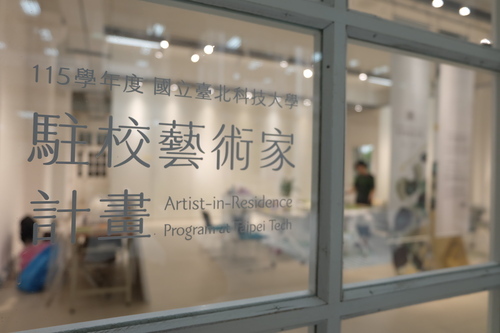
Huang Yi-Ting, Director of the NTUT Arts and Culture Center, stated that inviting an artist to work directly on campus gives faculty and students the opportunity to observe the creative process up close—from initial conception and experimentation to the completion of a work—and to experience how art takes shape within the campus environment. As part of the Artist-in-Residence Program, an artist talk is scheduled for mid-October this year, during which Huang will share her creative concepts and artistic experiences with faculty and students. A visual arts workshop is also planned for the following spring, offering participants the opportunity to engage directly in the process of artistic creation.
In addition to the residency and related exchange activities, the NTUT Arts and Culture Center will collaborate with Huang on a subsequent solo exhibition. Tentatively scheduled for November 2027, the “Huang Hua-Chen Solo Exhibition” will provide a comprehensive presentation of the works created during her residency and further extend the artistic dialogue between the artist and the university community.
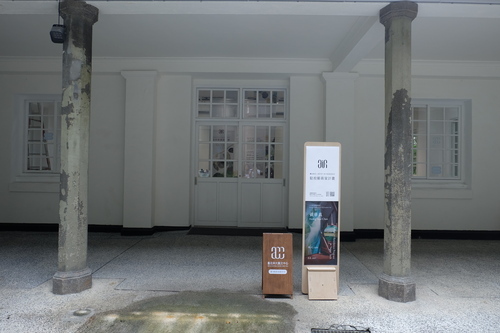
NTUT stated that through its Artist-in-Residence Program, it hopes to foster more direct interaction between artistic practice and campus life while continuing to expand exchanges in art, design, and the humanities upon its strong foundation in engineering, technology, and technical and vocational education. By inviting Huang Hua-Chen to work on campus, the university also hopes that her artistic practice and experience will introduce new ways of seeing within a science and engineering environment, integrating art into everyday campus life and enriching the educational and cultural experiences of faculty and students.